
Most of us were never taught how to handle a strong emotion at work. We were taught to hide it.
So we push it down, hold the meeting, answer the email, and carry the charge home. By evening it leaks out somewhere it was never about.
Here is the short answer, before the detail. You cannot think your way out of a stressed body. Emotional regulation at work is a set of small, physical, repeatable skills that calm the nervous system first and return clear thinking second. None of them require you to feel less. They help you stop being run by what you feel.
This guide covers what is happening in the brain when emotions spike at work, six techniques that actually move the needle, and a simple way to choose the right one in the moment.
Why emotions feel bigger at work
Work is full of social threat. A terse reply, a raised eyebrow in a review, a deadline that arrives early. To an older part of the brain, these read like danger.
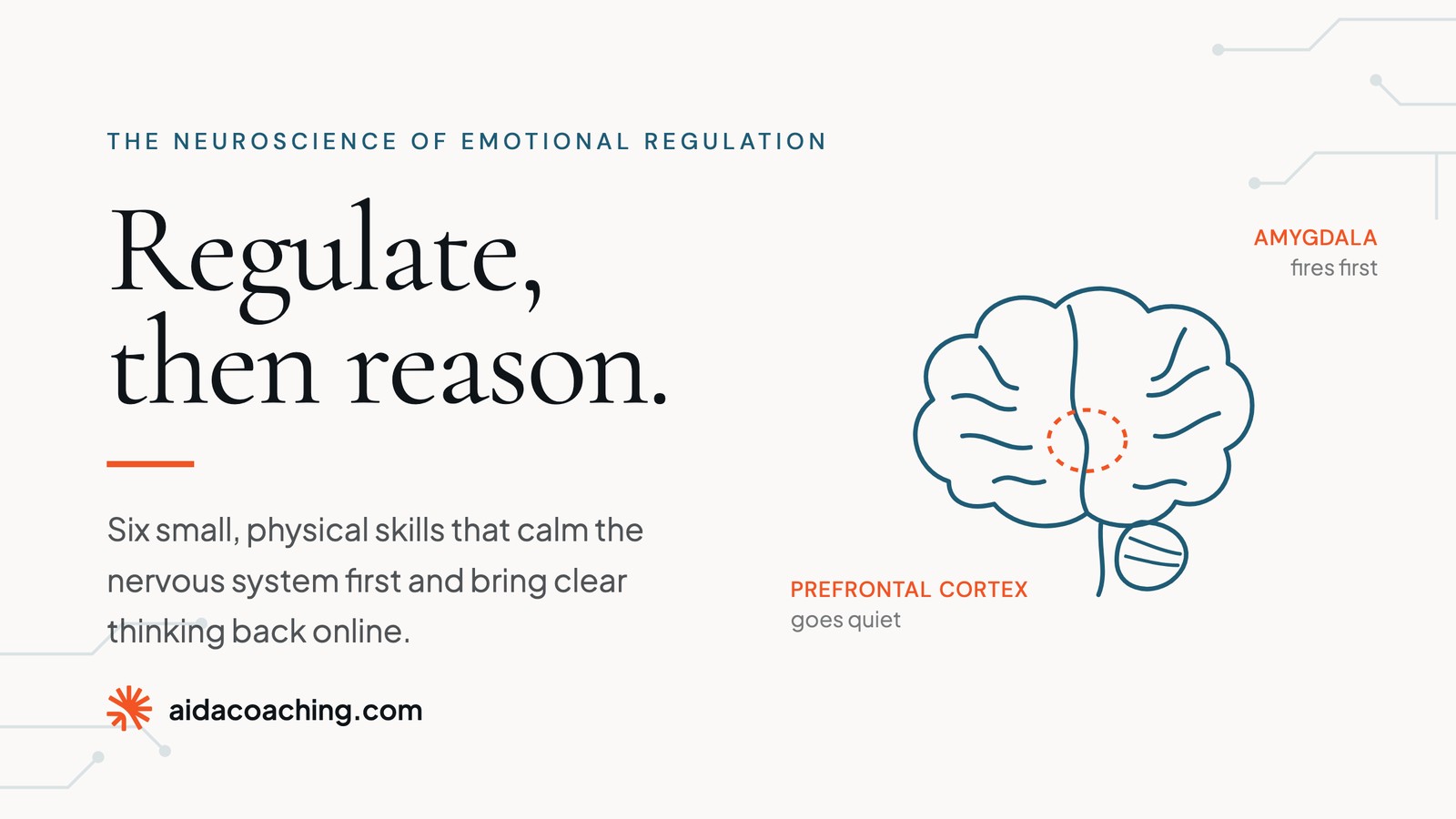
When that happens, the amygdala fires before the thinking brain gets a say. The HPA axis releases cortisol and adrenaline. Heart rate climbs. And here is the part that matters most for work: stress chemistry dampens the prefrontal cortex, the region you rely on for judgement, language, and self-control.
This is why you blank in the room, or send the email you later regret. It is not a character flaw. It is the design. The brain trades depth for speed when it senses threat.
Regulation is the skill of giving that thinking brain a way back online. Everything below is a route to the same place.
Six techniques that work
1. Name the emotion (affect labelling)
Putting a feeling into words reduces its intensity. Brain imaging studies led by Matthew Lieberman at UCLA found that labelling an emotion lowers activity in the amygdala. The researchers called it affect labelling.
In practice: say what you feel in plain language, even silently. “This is anxiety.” “This is frustration.” The feeling does not vanish. It stops running the room.
2. Buy ninety seconds
An emotion is, at root, a chemical event in the body. The neuroanatomist Jill Bolte Taylor describes a ninety-second window: the initial physiological surge of an emotion moves through and clears in roughly a minute and a half, if you let it.
What keeps it going longer is the story you tell on top of it. “How dare they.” “I always do this.” The chemistry is brief. The thinking is what loops.
In practice: when something hits, ride out the first ninety seconds before deciding what it means or what to do.
3. Lengthen your exhale
The fastest way to steady yourself in a meeting is also the most invisible. Make your out-breath longer than your in-breath.
A long exhale stimulates the vagus nerve, which shifts you toward the parasympathetic, rest-and-recover branch of the nervous system. Heart rate drops. The body reads it as a signal that the threat has passed.
In practice: breathe in for a count of four, out for six. No one can see it. You do not have to leave the room.
4. Step back from yourself (self-distancing)
You give better advice to other people than to yourself. Psychologists Igor Grossmann and Ethan Kross call this Solomon’s paradox: we reason more wisely about other people’s problems than our own, because distance cools the emotion that clouds judgement.
In practice: change the question. Not “why is this happening to me,” but “what would I tell someone I respect, sitting in exactly this spot.” Same situation, suddenly workable.
5. Put it on paper (expressive writing)
When a feeling sits heavy and you cannot name why, it stays in the body, vague and loud. Writing it down changes that. The work of psychologist James Pennebaker found that expressive writing, even for a few minutes, improves how people process difficult experiences.
In practice: take five minutes. Write what happened, what you felt, and what you are afraid it means. Once it is on the page, you stop being the feeling and start reading it. That distance is where clarity starts.
6. Decode the signal
Emotions are closer to data than to noise. Dread before a project points at something. Resentment after a yes points at something. Anger is often a value alarm: it tends to fire when fairness, respect, or honesty has been crossed.
In practice: instead of suppressing the feeling or acting on it, ask what it is reporting. “What value just got stepped on?” The answer usually tells you what to do next.
How to choose, in the moment
You do not need all six at once. A rough guide:
- If you are about to speak or send something and you feel the heat rising, use the exhale and buy ninety seconds.
- If a feeling is vague and won’t lift, name it, then put it on paper.
- If you are looping on the same event, step back and ask what you would tell a friend.
- If the same emotion keeps returning, decode it. It is reporting on a value or a need that isn’t being met.
One principle sits underneath all of them: regulate, then reason. Calm the body first. The good decision comes after, not before.
A note on the bigger picture
These techniques manage emotion in the moment. They are not a substitute for addressing what causes it. If most of your week is spent braced, if rest feels like exposure, if “I’m fine” has become automatic, that is worth listening to. Chronic stress is biological before it is psychological, and no breathing technique fixes a system that never gets to recover.
Regulation buys you the clarity to see that, and to choose differently.
FAQ
What is emotional regulation at work?
The ability to feel an emotion without being controlled by it. In practice it means calming the nervous system enough that your thinking brain stays available, so you respond on purpose rather than react on impulse.
Why do I lose my words under pressure?
Stress chemistry, mainly cortisol and adrenaline, temporarily dampens the prefrontal cortex, the part of the brain you use for language and judgement. A slow exhale before you speak lowers the threat signal and brings it back online.
What is the fastest way to calm down in a meeting?
Lengthen your exhale. Breathe in for four, out for six. The longer out-breath activates the vagus nerve and shifts your body toward its recovery state, without anyone noticing.
Does suppressing emotions at work help?
Not for long. Pushed-down feelings tend to resurface, often later and somewhere they were never about. Naming a feeling lowers its charge far more effectively than bottling it.
How long does an emotion actually last?
The initial physical surge of an emotion clears in around ninety seconds when you let it move through. What extends it is the story you keep telling about it.
Sonia Ouarti is a neuroscience-informed coach and founder of Aida Coaching. She holds an MSc in Psychology and Neuroscience from King’s College London and spent around 25 years in the tech industry including eight years as a senior leader at AWS.
References
Arnsten, A. F. T. (2009). Stress signalling pathways that impair prefrontal cortex structure and function. Nature Reviews Neuroscience, 10(6), 410–422.
Gerritsen, R. J. S., & Band, G. P. H. (2018). Breath of life: The respiratory vagal stimulation model of contemplative activity. Frontiers in Human Neuroscience, 12, 397.
Grossmann, I., & Kross, E. (2014). Exploring Solomon’s paradox: Self-distancing eliminates the self-other asymmetry in wise reasoning about close relationships in younger and older adults. Psychological Science, 25(8), 1571–1580.
Lazarus, R. S. (1991). Emotion and Adaptation. Oxford University Press.
Lieberman, M. D., Eisenberger, N. I., Crockett, M. J., Tom, S. M., Pfeifer, J. H., & Way, B. M. (2007). Putting feelings into words: Affect labeling disrupts amygdala activity in response to affective stimuli. Psychological Science, 18(5), 421–428.
Pennebaker, J. W. (1997). Writing about emotional experiences as a therapeutic process. Psychological Science, 8(3), 162–166.
Taylor, J. B. (2008). My Stroke of Insight: A Brain Scientist’s Personal Journey. Viking.